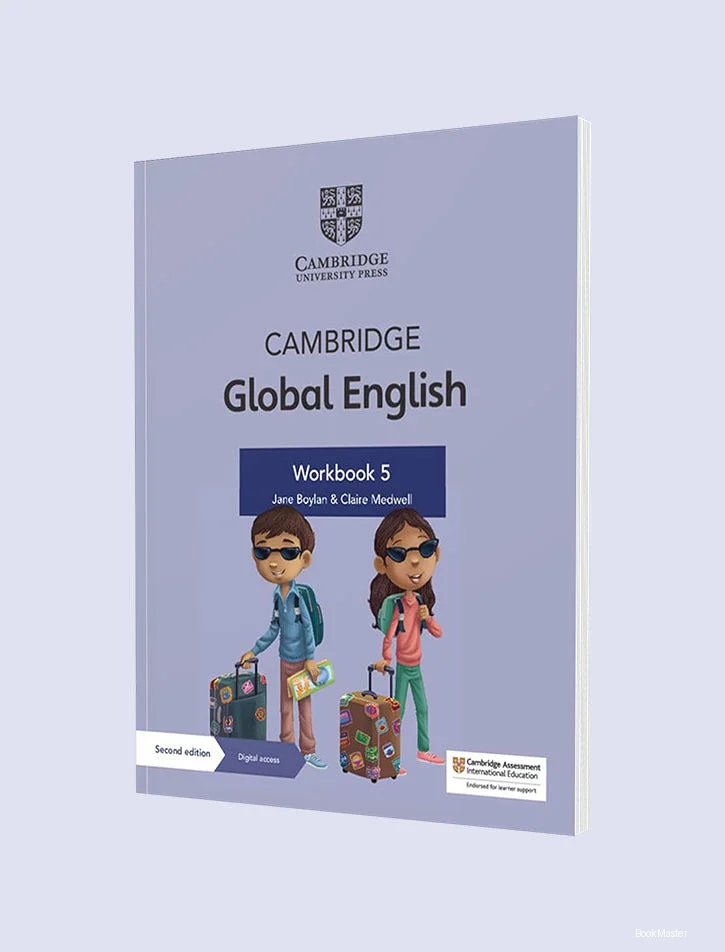
Cambridge Global English Workbook 5
Choose Your Version
Same book, different editions & conditions — tap one to switch.
Description
Synopsis
The Cambridge Global English Workbook 5 is an expertly structured, 9-unit practice journal tailored to support primary students learning English as a Second Language (ESL). Functioning as a direct companion to the Level 5 Learner's Book, this resource provides differentiated practice tiers (Focus, Practice, and Challenge) to accommodate diverse classroom settings. Through interactive crosswords, short language labs, and process-oriented writing frameworks, this workbook guides upper primary students into analytical thinking, advanced sentence generation, and formal reading comprehension.
3. Table of Contents (Units)
Unit 1: Talking about people (Personality traits, adjectives, present simple)
Unit 2: Food and health (Quantifiers, modal verbs for advice/obligation)
Unit 4: Places (Comparatives/superlatives, past simple, fictional/lost cities)
Unit 4: Special occasions (Defining relative clauses, future present continuous)
Unit 5: Our brains (Zero conditional, tag questions, science investigations)
Unit 6: Great stories (Connectives, past continuous vs. past simple, literature)
Unit 7: Ancient civilisations (Subordinate clauses, imperative forms)
Unit 8: Rainforests (Present perfect tense, adverbs of degree)
Unit 9: Animal kingdom (Habitats, passive voice structures, animal research)
4. Learning Outcomes (LO) / Objectives
By working through this Stage 5 workbook, students will fulfill the following curriculum goals:
Advanced Grammatical Application: Master complex structural frameworks including zero conditionals, question tags, relative clauses, and perfect tenses.
Tiered Skill Development: Successfully complete targeted writing and comprehension activities optimized across distinct tiers (Focus, Practice, and Challenge) to build independent fluency.
Process Writing Mastery: Confidently navigate the "Write About It" workflows, learning how to draft, format, and structure multi-paragraph essays and informational science reports.
Academic Cross-Curricular Vocabulary: Expand lexical knowledge into scientific, historical, and environmental terminology (e.g., neuroscience, archeology, and ecosystem metrics).
5. About the Author/Writer
Written by experienced international ESL curriculum developers Jane Boylan and Claire Medwell. Their pedagogies focus heavily on scaffolding language for young global learners, ensuring international standards meet classroom practicalities.
6. About the Publisher
Cambridge University Press is a globally trusted department of the University of Cambridge. They are renowned for providing pioneering educational resources, frameworks, and assessment tools mapped cleanly to international standards from early years up to advanced qualification pathways.